Showing posts with label day trips from Paris. Show all posts

Tuesday, June 14, 2011

Auvers sur Oise

After two passes through the town of Auvers sur Oise with my hiking group which offered little time to soak up the history of Vincent Van Gogh's final days there, I finally made the time to go back in early May.  With perfect weather and a great group of touring companions, it was certainly a day to remember.  And it's one that anyone visiting Paris can easily repeat themselves via commuter train from Gare du Nord in about 40 minutes.  There's just one change in Valmondois  or you can get off in Méry sur Oise and walk about 2.5 kilometers down the hill and across the river to Auvers.

And what to see when you get there?

There's the home of Dr. Gachet whose portrait by Van Gogh you probably know.


Views that inspired Cezanne which haven't changed too much since his day


The tiny room where Van Gogh lived during the last days of his life


A museum dedicated to absinthe, also known as the green fairy.


And of course there's the church immortalized by Van Gogh and the cemetery where you'll find his grave and that of his brother Theo.  I didn't take any pictures of those on this most recent trip but you can go back in time with me and see them here.   We didn't make it to the Daubigny museum nor to the chateau except to have an incredible picnic (yes, they actually let you sit on the grass!)

Art, history, country air, good friends, good food, and champagne.  Now there's a combo that's hard to beat.
 

Monday, June 6, 2011

Abbaye de Royaumont

I'm a little behind on reporting on some of my day trips from Paris.  The bare trees in this photo are a dead giveaway that I took this picture back in March and here it is already June.  But no matter the season, the Abbaye de Royaumont, some 30 kilometers north of Paris, is an interesting place to visit.  The first time I was there, maybe two years ago, was on one of my monthly hiking excursions in the forests around Paris.  It was a cold winter's day and we emerged from the woods, woods that otherwise were reminiscent of places on the East Coast of the U.S., to see this huge abbey across the road.  Yes, that's the kind of thing that happens all the time in France.  You're walking along in the forest and all of a sudden, there's something in front of you right out of a fairy tale. 

We wandered the grounds in search of a proper picnic place and then ducked inside to find the most palatial setting for our lunch.


Not bad huh? It was after all the abbey's one-time refectory.  I'm pretty sure that we weren't supposed to be doing that but the one uniformed staff member who peeked in the room while we were there -- muddy boots, thermoses of coffee, sandwiches, and all -- didn't say boo.

More recently, I went back for a proper guided visit and learned more systematically about the abbey's history.   Built in the 13th century by King Louis IX (better known now as St. Louis), the monastery operated continuously until the French Revolution when, like so many other religious properties in France, it was sold and repurposed.  The new owner decided that the stones that made up the church looked just right for building a cotton factory.  So he cut the pillars at the base, assuming that the structure would then collapse.  No luck.  Next, he got 100 head of cattle, roped them to the pillars, and had them pull in opposite directions.  That did the trick.  Today very little remains of the church although happily in addition to the refectory, the sacristy and cloister remain intact.


The property is now owned by the Gouin family who have not only done important renovations but have also transformed the abbey into a center for music and dance, offering both professional residencies and workshops, and a concert season that runs on weekends in September and October.

Open daily from 10 am to 6 pm

Wednesday, June 1, 2011

Pierrefonds

Viollet-le-Duc is best known for resurrecting Notre Dame from the ruin it had become by the mid 19th century but he also had his hands in a lot of other projects including the restoration of Carcassone in the southwest corner of France and the renovation of Pierrefonds, a castle just north of Paris, that became an occasional residence of Napoleon III.  Pierrefonds got its start in the 14th century as a military fortress guarding routes between Flanders and Burgundy.  In 1616, Cardinal Richelieu had it destroyed since it was always in the hands of those pesky Protestants.  It lay in shambles for centuries until Viollet-le-Duc was commissioned to bring it back to life.  And he did so in a manner that he imagined to be true to its medieval origins but ended up being more fantastic and over the top than scholars now believe to be accurate. 


If you've visited the Neuschwanstein, the castle built by Mad Ludwig of Bavaria around the same time, you will see the parallels between these two spaces, especially in their theatricality.  (Neuschwanstein has been featured in any number of films and TV shows; Pierrefonds is the backdrop for the popular BBC series Merlin.)  Then again, sometimes a little wild and crazy is just what you need to get through the day. 


About one hour and twenty minutes north of Paris
Open daily


Saturday, December 11, 2010

Villa Savoye

Long ago in a land far away, back when I was in college, I took a course on architectural history. And though I've forgotten quite a bit about the things I studied back then, I have never forgotten the images of the Villa Savoye, designed by Le Corbusier.

Finally yesterday, I had my chance to see it in person. I had some trepidation about road conditions in the Yvelines, the department west of Paris where the house is located, but in fact, once we escaped the traffic around Paris, the autoroute and local roads were clear and dry as a bone. And then when we entered the grounds, my heart sunk a bit. "That's it?," I thought. "That insignficant white box?" I was feeling particularly bad since it was at my suggestion that our group of 12 had made the trip.

Once inside, in the care of a charming and well-spoken architecture student, my fears dissipated. The interiors seemed twice the size I'd expected from the exterior.  And though the site began deteriorating almost from the minute it was completed in 1928, the sense of innovation and modernity remains firmly in place. The open plan, ribbon windows, and roof garden all create a sense of light and airiness that was inviting, even on cold gray December day.

Le Corbusier's "box in the air" now sits in a park one seventh the size of the original and on all sides, it's now hemmed in by ugly apartment blocks. The picture window on the roof terrace now frames several factories and industrial parks. Still, if you've got the time to make the trek out to Poissy (about 20 minutes by car from La Defense), it's well worth the visit.


Looking from the salon out to the hanging garden.  In nice weather, you can roll back the window separating inside from outside.  The chairs are copies of a Le Corbusier design.

The architect cleverly designed a way for the help to spy into the combination living room/dining room, a novelty at the time.  This sight line is from a seat lining one of the kitchen walls and goes through the passe-plat, where plates were readied for serving.

The Villa Savoye, a national monument, is located in Poissy, some 33 kilometers northwest of Paris.

Monday, November 22, 2010

Chateau d'Ecouen

After sharing my disappointment with the Medicis exhibit at the Musée Maillol, it's only fair that I bring to your attention something positive on the museum front.  As luck would have it, I not only have something upbeat to say but it's also about works from the same period.

Now the Chateau d'Ecouen is not exactly convenient -- it's located a good 20 kilometers north of Paris.  By road, it's not a particularly pretty drive.  And while you can get there by train from Gare du Nord, the station is a bit of a hike from the center of town.  But if you're up for adventure, go for it.  The building was the home of Anne de Montmorency, a man close to both France's great Renaissance king, Francois I and his son Henri II.  But this is not just a chateau; it's also the site of the Musée National de la Renaissance.  For an entry fee of just 5 euros, you get to see a castle almost entirely from the Renaissance era and a collection of tapestries, paintings, ceramics, furniture, and curiousities par excellence.  For every one precious object found at the Maillol exhibit, there are at least a dozen of the same type at Ecouen plus there's practically nobody there.  Seriously.  The galleries are large and well-lit and a plus for visitors at this time of year -- well heated too.  If you are up to pay a bit more, there are guided visits every Saturday and Sunday on specific themes.  If the guide is anything like the one I had, it is well worth the few extra euros and so much more engaging than an audioguide.

It was far too gray, gloomy, and chilly this week for a tour of the park but it looked pretty grand.  And if you have a car and the time, the Abbey of Royaumont is just a stone's throw away and well worth a visit itself. 

But don't take my word for it.  Go to the museum's Web site and take a look around.  Everything you need to know about the musee can be found right here.

Thursday, September 30, 2010

Lord and Lady of the Manor

ABC.  No it's not the first three letters of the alphabet.  It's the shorthand for a complaint I often hear from my kids: "another bloody church. "  There are also times when it can mean "another bloody castle!"

To be frank, I sometimes share my children's sense of fatigue.  That doesn't mean it's time to stop visiting castles and cathedrals.  Instead, you just have to start looking at them in a different way.  Otherwise, the dates, the locations, the interiors, and the exteriors will start to jumble in your mind like a crazy quilt of people and places. 

Earlier this week I had the occasion to go down to the Loire Valley for the day and visit two different castles known primarily for their gardens:  Villandry, which I had visited before many years ago, and La Chatonniere, which was completely new to me.  Now don't get me wrong.  Both of these places are worth a stop; actually they're even worthy destinations in their own right.  Villandry's gardens have been restored over many years of patient work to recreate the type of garden that was typical in France during the Renaissance.  They are rigid and formalized, all squares and gravel paths, with colors and designs that will simply wow you.  La Chatonniere is an old place with entirely new gardens, riots of color and imagination created from scratch since 1986 from what used to be primarily apple orchards. 

But it wasn't the gardens or the buildings that really captured my imagination.  Instead it was the owners with whom I was fortunate to spend a little bit of time.

Who owns a chateau?  Well it turns out two very different kinds of people who admittedly share similar passions for beauty and history as well as maintaining a family legacy. 

Henri Carvallo, owner of Villandry, is a soft spoken man in his late 40s, the great grandson of a Spanish doctor who purchased the property in 1906.  Slim and tanned in chinos and loafers, he doesn't get a second glance from the hordes of visitors roaming the house and gardens.  But oh the decisions he must make each day.   Each season, 250,000 flowers and vegetables are planted, half of which are prepared in the property's own greenhouses.  Recently, the beams in the chateau's attics were almost entirely replaced; had they not been, the facade might have crumbled into the court of honor.  And that's just the start.  There's the marketing and the planning, and keeping up with the finances, something at which Carvallo clearly excels.  He's been able to keep it all afloat just on gate receipts without a centime of government subsidies.

Béatrice de Andia, owner of La Chatonniere, couldn't be more different.  I'm guessing that she's in her 80s but still bubbles with energy and has a mind that's clearly firing on every cylinder.  She's nothing if not a character, having served for 30 years as general director of artistic action of the city of Paris, a lady who speaks French, English, and Spanish with ease,and once drove a Citroen 2CV from Paris to Saigon, stopping along the way for treks up Kilimanjaro and in the Himalayas. Since inheriting the property from her father, the 8th duke of Talleyrand, she's constructed 12 thematic gardens and has more in the works.   Theater and concerts en plein air are just part of the plan to keep the site interesting to visitors.

Carvallo and de Andia are clearly well grounded in the past.  But don't let their fidelity to history fool you.  You want to get to know them better?  They're both on Facebook.

Tuesday, September 21, 2010

Continued

Okay people, since you insist. I thought I might get away with just showing you a picture of that country house without spilling all the beans but apparently not.

In short, the house in question belongs to a lovely French lady who leads a conversation group I've been attending for the past two years. She has made it a tradition to invite the group to her place in the spring but in spring 2009, she was knee deep in renovations and this past spring, her husband was quite ill. So she rescheduled for last weekend. Although the group initially started last fall with around 15 members, only four of us faithfully attended until the end of the year and believe me, it was worth it!

With the addition of two spouses who made the trip, some two hours south of Paris, and the lady of the house and her husband, we were eight for lunch: aspic of asparagus with shrimp, roasted veal in a heavenly sauce of seasonal mushrooms, a cheese course, and a plum tart, all home-cooked. Monsieur poured a cremant from Burgundy for an aperitif (which then came with us to the table) and then followed with a red with the cheese. Meanwhile, the hostess regaled us with stories of her family through the ages. The property has been in the family since the 14th century although the house only since the early 18th. And despite some fabulous art work and furnishings, it's still very much a home as evidenced by the swing set in the yard and the stacks of puzzles, games, and doll furniture for the grandchildren. Not to mention the big screen tv which I didn't notice until much later in the afternoon when the master of the house could not resist checking out how France was doing in its Davis Cup match. FYI: they won.

After lunch, we set out for a walk around the property including forest and farmland. This is when I realized how clever I had been to choose low heeled boots as part of my tenue de campagne as suggested by the invitation. We walked for a good two hours, perfect on a lovely day and after that lunch. (Note to Sweet Freak: while Madame is usually a skirt, pumps, and sweater set kind of gal, on Saturday, she was sporting a pants suit and sandals, which she traded in for loafers for the walk.)

So there you have it. An unforgettable experience.

Monday, September 20, 2010

Rule No. 1


If a French lady of a certain age invites you to her country house for lunch, do not say no. And even if it's the holiest day of the year and you are supposed to be fasting, I'm pretty sure that, in the long run, all will be forgiven.

Thursday, July 8, 2010

Country Cute


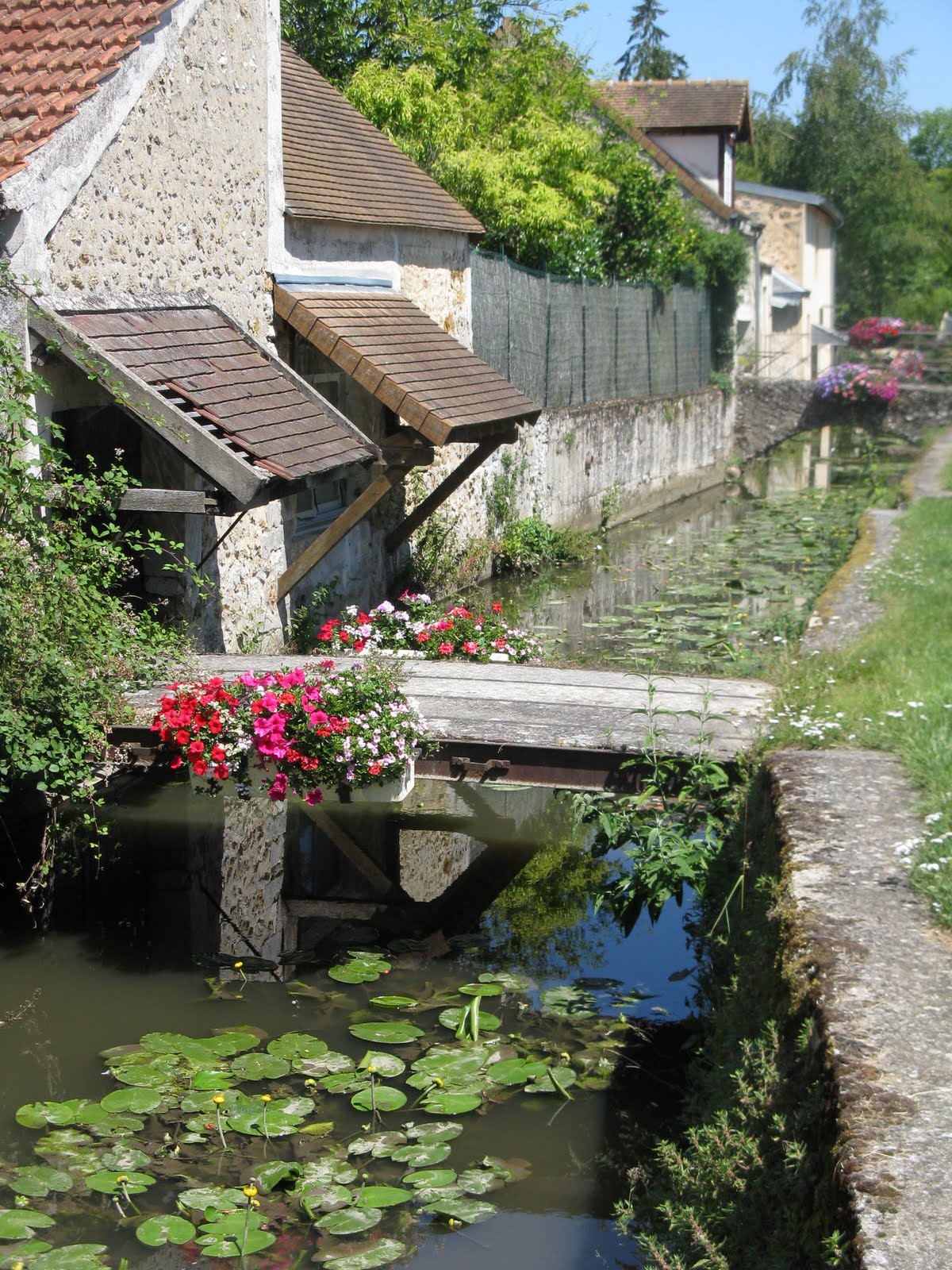
I'm sure it's not politic to say so but in my opinion, some of the smaller villages around Paris can be dreary little places in mid-winter, all grey stone, gates and shutters closed tight, everything silent except on market day. But in spring and summer, when those flower boxes and rose bushes get going, they really are something else. Well maybe not enough to charm me into small-town life but awfully darn sweet all the same.

Yesterday, my hiking group headed south of town to the department of the Yvelines for a long walk through the fields and forest between Coignières and Saint-Rémy-lès-Chevreuse. The loveliest stretch was along a small canal in the village of Chevreuse known as the promenade des petit ponts. In another age, the properties bordering the canal were all tanneries. But that's all a thing of the past and the only thing we encountered on this stretch was a group of elderly ladies sketching. They couldn't have picked a better spot.

Tuesday, July 6, 2010

Gien

Over the weekend, I packed my kids off to camp for a week and my husband is away on business for a few days so it's just me kicking around the house. I love them all but let me tell you. I'm kind of loving it. At least for the moment. I've got 72 hours on my own to do or not as I please, and I'm trying to find the right balance between getting things done and just enjoying myself.

So yesterday, with the company of a wonderful friend whose busy schedule has kept us from spending time together lately, I hit the road for a two hour drive to Gien, the town in the Loire Valley known primarily for its beautiful porcelain. These dishes are gorgeous but they're not cheap, and I've been wanting to check out the deals on seconds at the factory outlet for quite awhile.


Gien produces over 40 patterns so there was a lot to look at, although I quickly ruled out anything that wouldn't marry well with my blue and white Dansk. (A completely new set of china? Out of the question!) And then I just couldn't bring myself to pay 17 euros a piece for the dessert plates I'd been dreaming about. Still I didn't come away empty handed and there were definitely some bargains to be had. All seconds were priced at 35 percent below the regular retail price (and for the most part, the defects were not obvious to my eye) and there were additional markdowns of up to 50 percent on certain lines.

With lunch and a lot of time for girl talk coming and going, it was well worth the trip. If you're in Paris without a car, Point a la Ligne just off Place Victor Hugo in the 16th arrondissement is also offering second choice Gien at 30 percent off throughout this month (albeit with a much smaller selection). Gien also has boutiques at 18 rue de l'Arcade in the 8th and 13 rue Jacob in the 6th but I haven't been by to see whether they're offering any discounts right now.

Gien Earthenware Factory
Open Monday through Saturday (with the exception of holidays)
About 150 kilometers southeast of Paris

Friday, June 4, 2010

Saturday, May 29, 2010

And Speaking of Pigeons

I took another field trip out of town yesterday, to yet another privately owned chateau in the hinterlands of Paris, just past the industrial zone but not yet quite into the real countryside. And after visits to Fontainebleau on Monday, the newly renovated Hotel Talleyrand on Tuesday, and the American ambassador's residence on Thursday, I think I hit the interior decoration wall, pretty much going into a deep coma while the lady of the house described the furniture and the pedigrees of the ancestors whose portraits adorned the walls.

And then she took us out back to visit the pigeonnier and that's when my mind snapped back to consciousness. A pigeonnier, also known as a columbier, is basically a gigantic bird house but when I say gigantic, I mean, really really really big. It's got niches for 4,500 birds. Take a look.


Back in the day, you had to get the king's permission to have one of these and it was really indispensable, both in providing food for the domaine (in the form of both meat and eggs) and fertilizer for the vegetable gardens. So important was the latter (known as colombine) that it actually got mentioned in dowries.

Here's a look from the outside. The tower at the top was just for aeration. The pigeons themselves flew in and out of the tiny window (and one opposite). The lip below the window is designed to keep any rats, who might try scurrying up the side in search of dinner, from reaching their quarry. And just for good measure, that black strip below the lip is made of slate, making it extra slippery for those rats who are successful in scaling the wall.


Beyond the pigeonnier, the chateau de Saint-Jean de Beauregard also has a spectacular garden where the peonies and irises are currently magnifique and the roses are just getting started. A arts festival is on tap for the weekend of the 12th and 13th of June, so if you have a car and the weather is fine, you might consider making the trip.


Saint-Jean de Beauregard
28 km south of Paris in the Essone
www.domsaintjeanbeauregard.com

Thursday, April 22, 2010

Spring Stroll

Warm spring weather seems to be here to stay and what a difference it makes in my energy. A long walk and then a bike ride in the Bois de Boulogne, some quality playground time, and yesterday, a hike through forests and fields in the Essonne, less than an hour from the center of Paris by the RER C.

The crops looked incredible under the blue blue sky, especially the rapeseed which will eventually become canola oil.


We thought of the thousands stranded around the world when we saw these jet trails criss crossing the sky. It reminded me of that Saturday after September 11, 2001 when the planes started flying again, although this time without the sense of fear and dread.


We almost missed this neolithic structure, nestled into a bit of wood by the edge of a field.


After all the little yappy Yorkies with their furs and fancy coats who rule the streets of Paris, it was nice to see some big dogs. This fellow clearly just wanted to come out and play.

Monday, March 29, 2010

In Which I Visit Yet Another Chateau

How ya gonna keep 'em down on the farm
After they've seen Paree'


I'm afraid that old chestnut dating back to end of World War I is going to ring true for me in about 17 months. While we still have a good chunk of time left in our time in Paris, I already feel the clock ticking, the opportunities calling, and the regrets piling up of the things I don't have the time or energy to do.

But why mope? What got me started on this train of thought was my trip Friday out to where Ile de France ends and Normandy begins. And that's where, after passing through countryside and a series of small villages, you come around a corner and find this:


It's the 17th century Chateau d'Heudicourt. Louis XIV likely visited there on one of his many hunting escapades and Madame Heudicourt was a court favorite and dear friend to Madame de Maintenon who eventually became the king's wife. In the 19th century, it became the property of the Comte d'Esteve, Napoleon's treasurer, who re-did the facade and tamed part of the surrounding woods into a French garden, symmetrical and ordered in contrast to the wilder garden designs taking hold across the Channel.

Yeah, yeah, yeah, you're thinking, another chateau in a country thick with them and 19th century to boot. Scarcely worth a sniff from the real history buffs. But what's amazing to me, American that I am, someone whose family roots only go back so far before our immigrant history peters out into nothingness, the Esteve family is still in residence. Of sure, there are certain grand reception rooms reserved for guided visits, plus souvenirs from the time of the Sun King and the Emperor. But there are others more intimate with all the niceties of daily life in the 21st century.

The lady of the house is an old family friend of one of the ladies who organized the group visit. We all brought a covered dish to share. Fortunately, the cook decanted my Tupperware into something more appropriate for this milieu.


Holy cow. Lunch in a chateau. With a comtesse. What's it going to be like to be back at work, grabbing a turkey sandwich to eat at my desk? I guess I should just try to enjoy it while it lasts.


The gardens of the Château d'Heudicourt are open Sunday afternoons in June and everyday during the months of July and August. Last year, the chateau itself was open during les Journées du Patrimoine in September.

Saturday, February 20, 2010

Maison Louis Carré


I have strong opinions about many things but when it comes to exploring Paris and its environs, I have no standards at all. Wherever you're going, whatever you're doing, I'm pretty much game. So when I had the opportunity to visit a private home designed by Finnish architect Alvar Aalto in Bazoches-sur-Guyonnes, about 40 kilometers southwest of town, I said, "sign me up."

Aalto designed the home for Parisian art dealer Louis Carré who moved there in 1959. From the exterior, it's not much to look at but the feeling completely changes once you walk in the front door. It's built like a wave into the side of a hill with commanding views of the surrounding countryside in every direction. Aalto designed it all (with help from a few collaborators) including the furniture, carpets, lighting, and the two most amazing walk in closets I've ever seen.

Carré picked the site because it's just across the road from where his friend, Jean Monnet, one of the architects of the European Union, lived. You can visit Monnet's house too, an interesting contrast since it's a typical French country house complete with thatched roof and fussy furniture. Frankly, either one would suit me just fine.

Both sites are open to visitors but at odd hours depending upon the season. Check the Web sites before you go:

Maison Louis Carré

Maison de Jean Monnet

There's lots more to see in this neck of the woods if you have a car and the time. I had lunch in the picture perfect village of Les Mesnuls before heading back into town but had no time to explore the church or the town's own chateau.

Thursday, February 4, 2010

Yet Another Walk in the Woods


I didn't expect to get any sympathy yesterday and I sure didn't get any. But I had a great walk in the woods from St. Nom La Breteche to St. Germain en Laye with wonderful company. The trains were scarcely running but the turnstiles were open and the ride was free. Although the trail was quite muddy, the weather gods conspired to give us a day considerably less chilly than Tuesday. The rain was fleeting and we found a nice sheltered spot for lunch; under the tree, the pine needles were scarcely damp.

The highlight of the walk came at the end and began with short steep uphill to this amazing circle of trees.


We turned to the right and there was a long promenade poised on the edge of a cliff looking to the east. The promenade stretched over a kilometer, from the forest to the chateau and the town.


What once were farms with orchards, pastures, and vineyards to feed the court when they were ensconsed at the chateau is now a mix of fields, housing, highways, railways, and all manner of urban civilization. We had a grand view of La Défense with the bonus of the ever present Eiffel Tower and the Tour Montparnasse in the distance.

Saturday, November 14, 2009

Chateau de Monte-Cristo


It's not really a chateau, it's not even really French either, and for that matter, there is no Monte Cristo in France (just a volcanic island off the coast of Italy) and no count either. But who cares? Alexandre Dumas, the author of The Count of Monte Cristo, The Three Musketeers, and dozens of other over-the-top novels and plays, pulled himself up by his bootstraps and built a place to call his own. He borrowed details from the Renaissance, the Gothic, the Moorish, and half a dozen other styles in a great mess of house where he could entertain. He did his writing in a separate building perched atop a hill facing the main house, nicknaming it the Chateau d'If, after the prison in the harbor in Marseille where his count was unjustly imprisoned for so many years. Dumas lived large, producing an incredible body of work, and enjoying a reputation as a gourmand, a generous friend, and completely inept when it came to money. He lost the house just two and half years after he built it.


While this was once in the countryside, just two steps from the Seine, today suburbia has encroached upon Le Port Marly and two busy highways and a train track separate the house from the river. Happily, it's only a half hour's drive west from Paris and definitely worth the trip, that is if you have wheels or someone else to drive you. (I can't imagine there's any easy way to get there via public transportation.) Call ahead though because it's only open at odd hours in the winter months.

Chateau de Monte-Cristo

Monday, July 27, 2009

Champagne without the Bubbly


Call me crazy but I went to Champagne on Saturday and didn't drink any. In our last ditch effort to have grownup fun while the kids were at camp, my husband and I took a day trip to Reims, the heart of Champagne, but we had other things in mind. And to tell you the truth, while I like wine just fine, having visited vineyards in France and California, the whole tasting thing kinda leaves me cold. But even minus champagne, our day in Reims was really special. We enjoyed strolling around town, stopping for coffee and later lunch, and touring the cathedral, the basilica of St. Remi, and the Palais de Tau, home for many years to the region's archbishops. Reims is full on Gothic but gets a special place in history as being the site where Clovis, the first king of the Franks was baptized, and it subsequently became the official site for French coronations. Heavily damaged by fire and war throughout the centuries, the cathedral remains a work in progress. New windows were created after the Second World War, including a lovely set by Marc Chagall, and new technology is now permitting 21st century artisans to create perfect replicas of existing statuary so the authentic pieces can be brought inside, away from the degrading effects of weather and pollution.


How is it that a Russian Jew ended up making windows for a French Catholic church? Who cares? These windows are spectacular.


The contrast between the restored sections and those still in need of work was stark. Blame the missing body parts on the Germans, the French Revolution, and the passage of around 800 years

Reims is an easy 40 minutes from Gare de l'Est by TGV. If you want to visit the vineyards, a car makes more sense. There are half a dozen other sights to see in the area including a museum at the site where General Eisenhower accepted the surrender of the German forces in 1945 and another one devoted to vintage cars. You could easily make a weekend of it.
Related Posts with Thumbnails