An unopened jar of tamarind paste bought for some recipe, which one I no longer remember. Half finished bottles of orange flower water and pomegranate molasses. Three cans of sardines that I purchased mistakenly assuming they were anchovies. Half a package of gelatin sheets. A box of tapioca and a can of bamboo shoots left to me by departing expats.
What does this stuff have in common? Well, it's all sitting in my kitchen cabinets or in the door of my refrigerator, and I've got about four months to use it up or toss it. And I'm too much my mother's daughter (and she was a child of the Depression) to not wince at the thought of wasting good food.
The reality of our departure is becoming more vivid as the days pass. I'd thought about putting a countdown ticker here on my blog but happily as our exact date is not yet set, there's no point in having a depressing daily reminder of it. In fact, I'm not sad (not yet), just busy, both trying to take advantage of what Paris has to offer and to take care of all the practical details. So if you have a good recipe that uses any or all of the above, send it my way. We may be doing some pretty strange eating around here but at least we'll still be doing it in Paris.
Wednesday, March 2, 2011

Tuesday, March 1, 2011
Les Serres d'Auteuil

So my advice to you is to get off your duff and make your way to Auteuil as soon as possible, or at the very least sometime this spring when the outdoor gardens will begin to bloom in earnest. What's more, entrance to the greenhouses is free and open 364 days a year (Christmas excepted) from 9:00 am to 4:45 pm.
And here's a hot tip: in the biggest greenhouse known as the Palmarium, there are tables and chairs just waiting for you to come have a picnic. It's strictly BYOB (and for that matter everything else too) but absolutely allowed. Doesn't that sound better than a cup of crummy Parisian coffee on a terrasse filled with smokers?


Metro: Porte d'Auteuil
Free entry
Monday, February 28, 2011
Budapest

Budapest's streetscape is a sprawling patchwork of crumbling 19th century grandeur, bleak Soviet era architecture, and a mishmash of what's cropped up, for better and for worse, since the fall of Communism in 1989. There are broad boulevards, stone plazas, quirky statuary, and an idyllic city park. And then there's the Danube, which separates the hills of Buda from the flatlands of Pest. The city was bombed heavily in World War II. Much was rebuilt and then neglected; in contrast to the bright white limestone of Paris, many buildings are dark with soot and pitted by acid rain. A few well managed rehabilitation projects suggest, however, that perhaps there's a brighter future ahead.
And for the tourist, there's plenty to keep one busy. Our two favorites were the House of Terror, the former headquarters of both the fascist and Communist secret police made into a chilling and compelling modern museum, and the Szechenyi baths. If you had told me two weeks ago, that I'd be enjoying a dip in an outdoor swimming pool on a day when the temperatures were hovering around 0 degrees Centigrade, I'd have told you that you were nuts. But with sunshine and a clear blue sky, an amazing Neoclassical setting, and a water temperature of 36 degrees Centigrade, it was hard to beat. Follow that with a hearty chicken paprikash and a nice glass of Hungarian red, and you've got a vacation.
 |
| Four story collage of victims of terror at the hands of fascists (German and Hungarian) and Communists |
 |
| Couldn't resist getting a shot of the "So Frenchy" sandwich. |
 |
| I found this inscription on the window of an elegant restaurant enigmatic -- why only for those with small appetites? |
 |
| Saturday and Sunday, we were treated to folk dancing performances on the plaza just outside the apartment where we stayed. |
Saturday, February 26, 2011
Through These Portals Pass

Doorways seem to be a big favorite for travel photographers. Is it the visuals themselves or the imaginings of what's happening within that most enchants? My guess it's probably a little of both. Since so many other people are busy sharing their doorway pics, and because it's hard to capture a door in Paris without the image of a parked car directly in front of it, I've shied away from taking too many myself. And as much as I liked this doorway with its spectacular caryatids (somewhat spoiled by their no parking signs), I realize now that it's a bit crooked.
No matter. There's something that makes this doorway, somewhere on an obscure street in the 16th arrondissement, noteworthy. Take a look at what's been carved directly over the door itself:

The inscription reads:
Lasse des vains espoirs et des bruits de la terreHeureuse d'oublier, l'une a fermé les yeux....
A son premier matin, sans effroi du mystère,
L'autre aspire à la vie en souriant au cieux !
Tired of false hopes and the sounds of the earth
Happy to forget, one has closed its eyes.
On his first morning without fear of mystery,
The other aspires to life, smiling in heaven!
A little sleuthing determined that the architect of this residence was Paul Sédille best known for his work on the Printemps department store. As for the author of the verse or its significance at this location, I haven't got a clue.
Friday, February 25, 2011

Thursday, February 24, 2011
Cycling Lesson

This is for all the parents out there who ever taught a kid to ride a bike. Although the end result is thrilling (watching your kid experience the freedom of pedaling solo is truly like nothing else), the hours you have to put in can be tedious. Plus all that hunching over really does a number on your back. (Full disclosure: it was my husband who did all the heavy lifting in this department for our two kids.)
Learning to unicycle takes a special kind of determination. I walked behind this father-daughter duo for several blocks; she never managed to make it more than two or three revolutions without falling off. Dad, for his part, kept his iron grip on both her hand and his cell phone. Perhaps he's not the model of parental attention but I give him full credit for being out there on a chilly Sunday, giving her a chance to learn a new skill, especially in a city where there are not a lot of venues for this sort of activity.
And if she doesn't make it into that classe préparatoire a couple of years hence, if she sticks with the unicycle, there's an open plaza in front of the Centre Pompidou just waiting for another street performer.
Wednesday, February 23, 2011
Miscellany of History
You can barely walk down the street in these parts without encountering a piece of history. Little memorials, plaques stuck to the side of buildings, brass markers seem to be everywhere, almost as ubiquitous as that other stuff on the sidewalk (although I think I've already said quite enough about that) and absolutely more welcome. Here are a just a few of the little bits of history I've encountered lately.


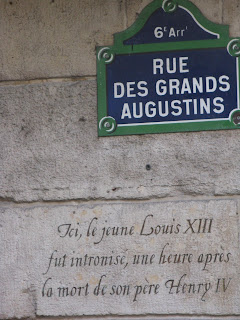
Carved inscription on a building of no particular importance today indicating the spot where the young Louis XIII was made king after the assassination of Henri IV. He was only eight at the time; his mother Marie de Medici served as regent until he reached majority at the age of 13.


In Parc Monceau, the spot where in October 1797, Andre-Jacques Garnerin made the world's first parachute jump.


On my monthly hike outside of Paris, a small plaque noting the residence of the jazz guitarist Django Reinhardt in the charming little town of Samois sur Seine.

Carved inscription on a building of no particular importance today indicating the spot where the young Louis XIII was made king after the assassination of Henri IV. He was only eight at the time; his mother Marie de Medici served as regent until he reached majority at the age of 13.


A marker designating a building on rue des Colonnes, one of the few buildings constructed in Paris during the Revolution. This arcade preceded, but surely inspired, the one now present on the rue de Rivoli. The decorative work on the capitals is unlike anything else you'll find in Paris.
Subscribe to:
Posts (Atom)


